


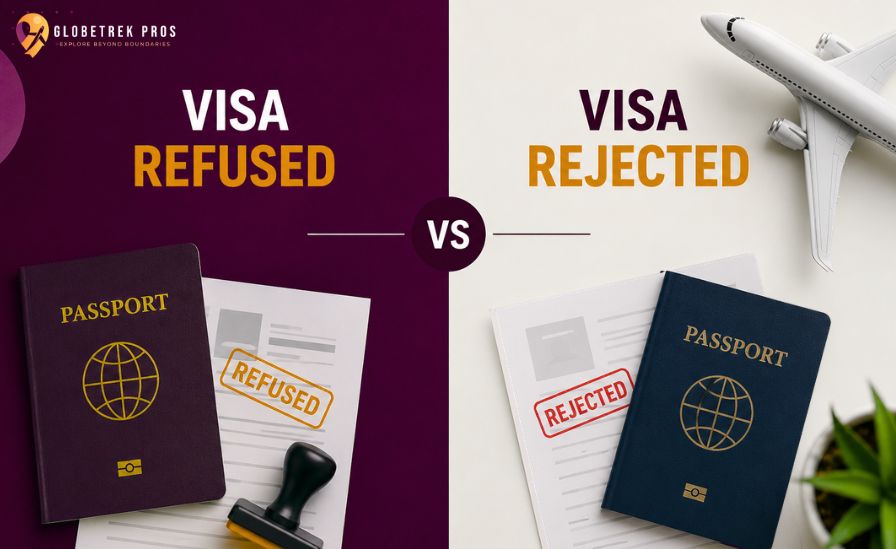
Visa Refused vs Visa Rejected – What’s the Difference?
Applying for a visa can be both exciting and stressful. However, receiving a refusal or rejection can be disappointing—especially if you don’t understand what it actually means.
Many travelers use the terms “visa refused” and “visa rejected” interchangeably, but in many cases, they have different meanings depending on the country and immigration authority.
Understanding the difference can help you avoid future mistakes and improve your chances of obtaining a visa.
At GlobeTrek Pros, we guide travelers through every step of the visa application process to help them submit stronger and more accurate applications.
What Is a Visa Refusal?
A visa refusal generally means that the immigration officer has reviewed your application and decided that it does not meet the requirements for approval.
A refusal usually happens after your application has been fully assessed.
Common reasons include:
- Insufficient financial proof
- Weak travel history
- Incomplete or inconsistent documentation
- Unclear travel purpose
- Failure to satisfy visa requirements
Depending on the country’s immigration rules, you may be able to reapply after addressing the issues.
What Is a Visa Rejection?
A visa rejection often refers to an application that is not accepted because it contains errors, missing documents, or fails to meet basic submission requirements.
In many cases, a rejection occurs before a detailed assessment of your application.
Examples include:
- Missing required documents
- Incomplete application forms
- Invalid passport
- Incorrect application category
- Failure to attend a biometric appointment when required
Many of these issues can be corrected before submitting a new application.
Important: Some countries use the terms “refused” and “rejected” differently—or even use only one of the terms for all unsuccessful applications. Always refer to the official decision letter issued by the relevant immigration authority.
Visa Refused vs Visa Rejected: Key Differences
| Visa Refused | Visa Rejected |
|---|---|
| Application was reviewed by a visa officer | Application may not meet basic submission requirements or may not proceed to full assessment |
| Usually relates to eligibility concerns | Often relates to missing information or submission errors |
| May require stronger supporting documents before reapplying | Usually requires correcting errors and submitting a new application |
| Decision is based on immigration assessment | Decision is often based on application completeness or validity |
Common Reasons for Visa Refusal
Even well-prepared applicants can receive a visa refusal.
Some common reasons include:
Weak Financial Documents
Your bank statements may not demonstrate sufficient financial stability or consistency.
Unclear Purpose of Travel
If your travel plans are not well explained or supported by documentation, the visa officer may not be convinced.
Weak Travel History
Applicants with little or no international travel history may require stronger supporting documents.
Inconsistent Information
Differences between your application form, supporting documents, and interview responses can create concerns.
Lack of Strong Home Country Ties
Visa officers want confidence that you will return home after your visit.
Common Reasons for Visa Rejection
Some applications are rejected because of avoidable mistakes.
These include:
- Missing documents
- Incorrect information
- Expired passport
- Unsigned application forms
- Applying under the wrong visa category
- Missing appointment requirements
These problems can often be prevented with careful preparation.
Can You Apply Again?
Yes.
Receiving a refusal or rejection does not always mean you cannot apply again.
Before submitting a new application:
- Understand the reason for the previous decision.
- Correct any mistakes.
- Strengthen your supporting documents.
- Ensure your financial records are consistent.
- Prepare a clear travel itinerary.
A stronger application often has a better chance of success.
How to Reduce the Risk of Visa Problems
You can improve your application by:
- Providing complete and accurate documentation.
- Maintaining stable financial records.
- Building a positive travel history.
- Preparing a professional travel itinerary.
- Being honest throughout the application process.
Careful preparation significantly reduces avoidable mistakes.
How GlobeTrek Pros Can Help

At GlobeTrek Pros, we help travelers prepare stronger visa applications through professional guidance and personalized support.
Our services include:
- Visa consultation
- Document review
- Cover letter preparation
- Travel itinerary planning
- Flight and hotel reservations
- Travel insurance guidance
Our experienced team works to ensure every application is complete, accurate, and professionally prepared.
Understanding the difference between a visa refusal and a visa rejection can help you respond appropriately if your application is unsuccessful. While the terminology may vary between countries, the most important step is to carefully review the official decision, correct any issues, and submit a stronger application if you choose to reapply.
With proper preparation and expert guidance, many applicants successfully obtain their visas after improving their documentation and application strategy.
If you’re planning your next international trip, GlobeTrek Pros is here to help you navigate the visa process with confidence.
Frequently Asked Questions (FAQs)
1. Is a visa refusal the same as a visa rejection?
Not always. The meaning can vary depending on the country’s immigration system. Always read the official decision letter to understand the reason for the outcome.
2. Can I apply again after a visa refusal?
Yes. In many cases, you can reapply after addressing the issues that led to the refusal.
3. Does a visa refusal affect future applications?
A previous refusal may be considered in future applications, but it does not automatically prevent you from obtaining a visa if your new application is stronger.
4. How can I improve my chances of visa approval?
Submit complete and accurate documents, maintain stable financial records, provide a clear travel purpose, and ensure all information is consistent.
5. How can GlobeTrek Pros help with my visa application?
GlobeTrek Pros provides professional visa consultation, document review, travel planning, and application guidance to help travelers prepare stronger visa applications.

